

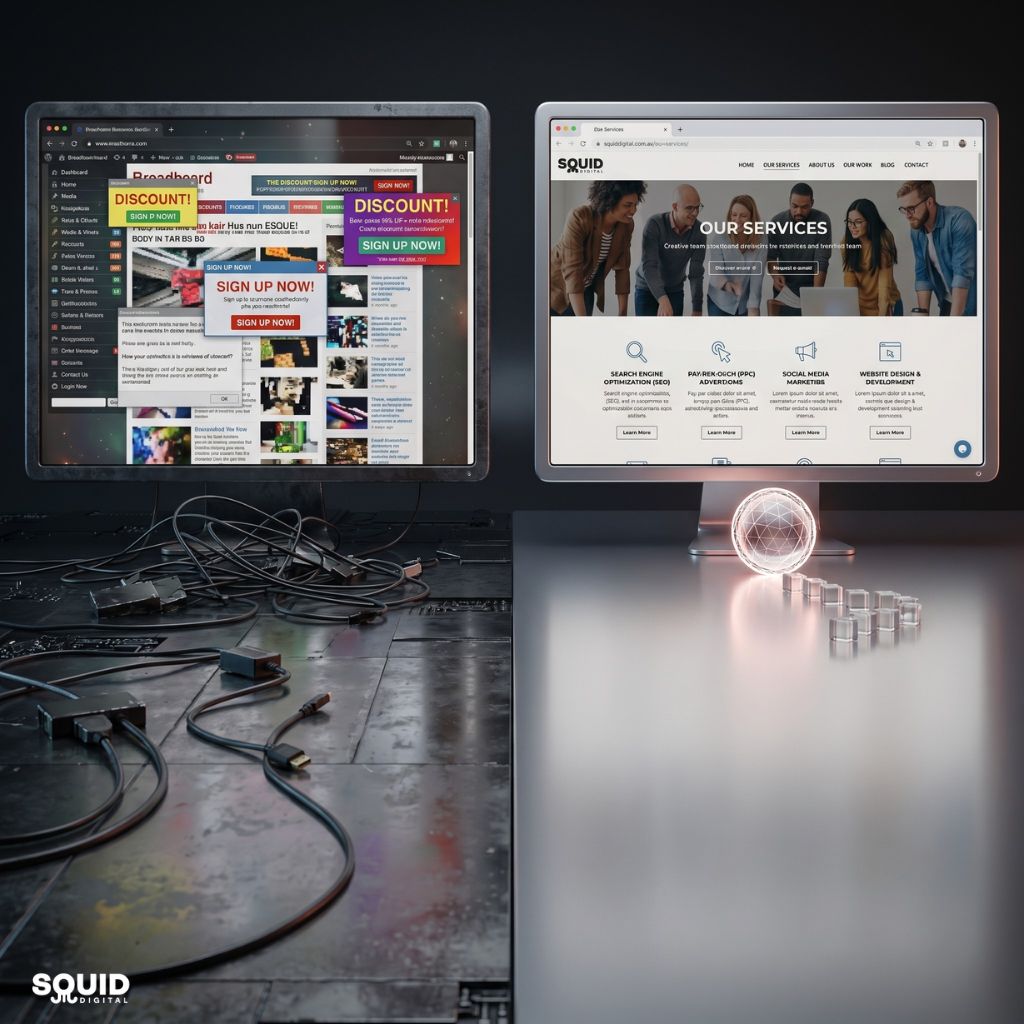
How to Make Your Website AI-Readable (Not Just Google-Readable)
For years, “optimising your website” mostly meant one thing: making Google happy.
Keywords in the right places.
Meta tags filled out.
Backlinks slowly earned.
That still matters. But something has quietly shifted.
Your website is no longer just being read by search engines.
It’s being interpreted by AI.
And AI doesn’t behave like Google.
It doesn’t just rank pages – It summarises them.
It doesn’t just crawl links – It answers questions using your content.
It doesn’t send traffic the same way – It sometimes replaces the need to click at all.
Which means: If your site is only built to be “Google-readable,” you’re already behind.
The real difference: ranking vs understanding
Google’s traditional model is about ranking relevance.
AI’s model is about extracting meaning. That sounds subtle, but it changes everything.
A Google-optimised page might:
- Target a specific keyword
- Repeat variations of that keyword
- Structure content for ranking signals
An AI-readable page, on the other hand:
- Clearly explains a concept
- Connects ideas logically
- Anticipates real questions a human would ask
In short, AI cares less about what you say repeatedly…and more about how clearly you say it once.
Why this matters (more than most people think)
We’re already seeing AI-generated answers in search results, chat interfaces, and assistants.
And when AI pulls from websites, it tends to favour content that is:
- Easy to interpret
- Well-structured
- Context-rich
- Free from fluff
If your site is vague, overly keyword-stuffed, or written like it’s trying too hard to rank… It becomes invisible in a different way.
Not buried on page 2.
Just not used at all.
What makes a website AI-readable?
There’s no single checklist. But there are patterns.
1. Write like you’re explaining, not performing
A lot of web content still feels like it’s trying to impress an algorithm.
AI doesn’t need impressing. It needs clarity.
Instead of “We leverage innovative, cutting-edge digital solutions…”
Try “We help businesses fix messy websites so customers can actually find what they need.”
Simple wins.
Not because it’s “dumbed down,” but because it’s unambiguous.
2. Structure your thoughts properly
AI loves structure. Not rigid templates—but clear hierarchy.
Think:
- Headings that actually describe what follows
- Short sections focused on one idea
- Logical flow from problem → explanation → outcome
If a human can skim your page and understand it in 30 seconds, AI can probably interpret it well too.
If a human gets lost halfway through… AI will too.
3. Answer real questions (the ones people actually ask)
This is where most websites fall short.
They describe services.
They list features.
They talk about things.
But they don’t answer questions like:
- “Is this right for me?”
- “What happens after I click this?”
- “How long will this take?”
- “What could go wrong?”
AI systems are built around questions.
So if your content doesn’t naturally answer them, it becomes harder to extract value from.
4. Add context, not just keywords
Old SEO thinking: include the keyword multiple times.
AI thinking: explain the topic fully enough that the meaning is obvious.
For example, a page about website redesigns shouldn’t just say “website redesign” repeatedly.
It should naturally include:
- Why businesses redesign
- Common problems with old sites
- What improves after a redesign
- How the process works
This builds a semantic web of meaning—something AI relies on heavily.
5. Be specific (generic content gets ignored)
AI has read everything.
If your content sounds like it could belong to any business in your industry… it won’t stand out.
Specificity signals credibility.
Compare: “We improve your online presence.” vs “We fix slow-loading pages, remove dead-end navigation, and make sure enquiries don’t disappear into broken forms.”
One is vague.
The other is usable.
AI tends to favour the second—because it’s grounded in reality.
6. Reduce fluff (seriously)
This one’s uncomfortable.
A lot of website copy is padded. Not intentionally—it just happens over time.
But AI is very good at spotting when content says a lot without saying much.
If a paragraph can be cut in half without losing meaning… it probably should be.
7. Make your content “quotable”
Here’s a useful test: Can a single paragraph from your page stand on its own and still make sense?
Because that’s often how AI uses content. It pulls snippets. Summaries. Fragments.
If those fragments are clear, insightful, and self-contained, your chances of being referenced increase significantly.
A quick reality check
You don’t need to rewrite your entire website overnight.
But you do need to shift how you think about it.
Instead of asking: “Is this page optimised for search?”
Start asking: “Would an AI confidently use this to answer someone’s question?”
That one shift changes how you write, structure, and prioritise content.
Where most businesses will get stuck
Not in the technical side.
In the writing.
Because writing clearly is harder than it sounds.
It forces you to:
- Actually understand what you do
- Strip away jargon
- Say things directly
And that’s uncomfortable—especially if your current content has been “working” (or at least existing) for years.
The opportunity (if you get this right)
Most websites haven’t adapted yet. They’re still written for an older version of the internet.
Which means there’s a window right now where:
- Clear, structured, genuinely helpful content stands out
- AI systems are actively looking for better sources
- And small improvements can have outsized impact
Not just in traffic.
But in trust.
Final thought
Google taught us how to be discoverable.
AI is forcing us to be understandable.
And the businesses that win won’t be the ones with the most content…
They’ll be the ones whose content actually makes sense.
If you want a second pair of eyes on it, we’re happy to take a look and show you exactly where AI (and your customers) might be getting lost—no jargon, no fluff, just practical insights you can actually use.