

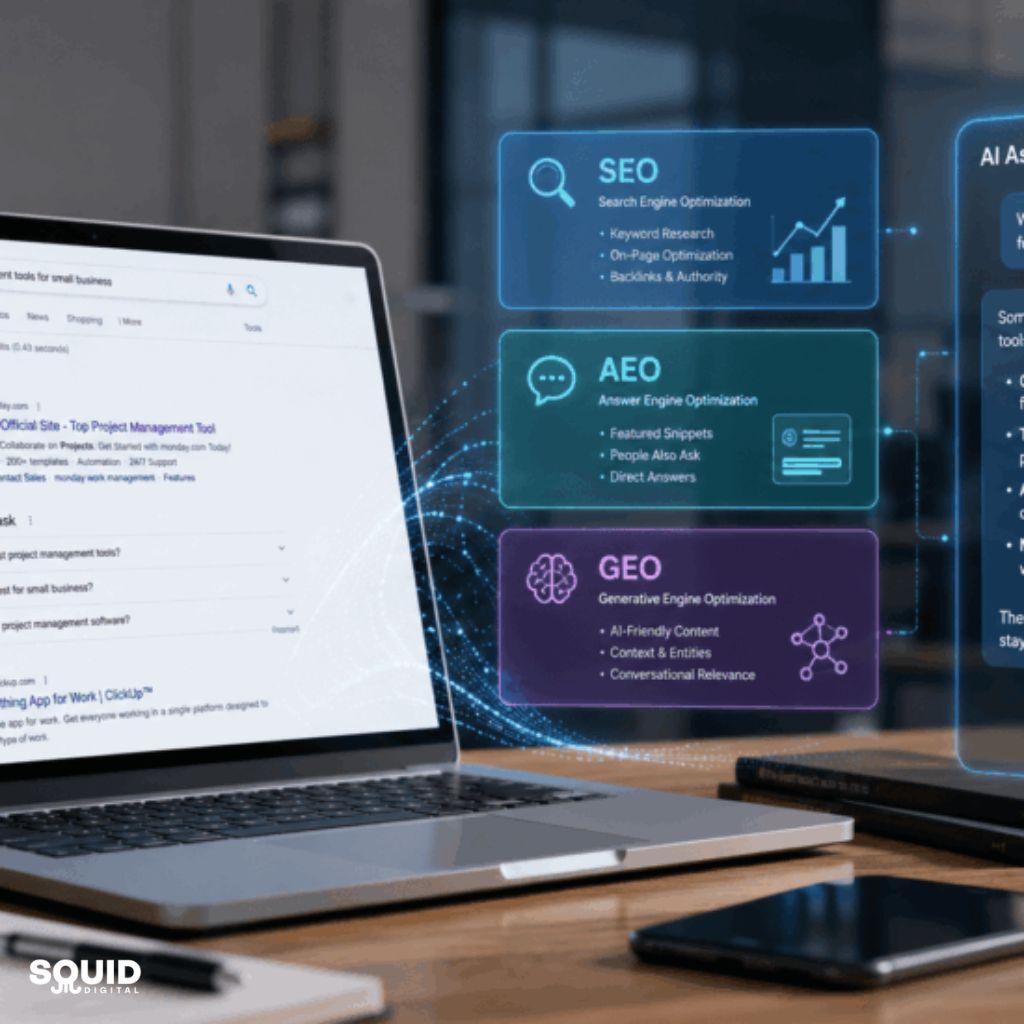
SEO vs AEO vs GEO: What Actually Matters in 2026
SEO vs AEO vs GEO is no longer just a technical debate—it’s a practical decision that directly affects how visible your business is online in 2026. If you’re still focusing only on traditional search rankings, you may already be losing ground to competitors appearing in AI-generated answers and featured snippets.
Search behaviour has changed. Users now expect instant, accurate responses—often without clicking through to a website. That shift has introduced Answer Engine Optimisation (AEO) and Generative Engine Optimisation (GEO) alongside traditional SEO.
In this guide, you’ll learn:
- What each approach actually means
- How they differ and overlap
- Why they matter for small businesses
- How to apply all three in a practical, structured way
The Evolution of Search: From Rankings to Real Answers
Search has shifted from “finding links” to “getting answers”. Understanding this change is key to adapting your strategy.
What SEO Means Today (and How It Has Changed)
SEO is still the foundation of online visibility. It focuses on helping your website rank in search engines like Google.
Modern SEO includes:
- Matching user intent, not just keywords
- Creating high-quality, useful content
- Ensuring technical performance (speed, mobile usability)
However, ranking alone no longer guarantees clicks.
Defining AEO (Answer Engine Optimisation)
AEO is about providing direct, concise answers to user queries.
This includes:
- Featured snippets
- Voice search responses
- “People also ask” boxes
The goal is simple: be the answer, not just a result.
Understanding GEO (Generative Engine Optimisation)
GEO focuses on optimising content for AI-generated responses from platforms like ChatGPT and generative search tools.
It prioritises:
- Context-rich information
- Clear structure
- Trustworthy, accurate content
Instead of ranking, your goal is to be referenced or summarised by AI.
Why These Three Are No Longer Separate Strategies
Search is now layered:
- SEO helps you get discovered
- AEO helps you get selected
- GEO helps you get cited
You can’t rely on just one anymore.
SEO vs AEO vs GEO — What’s the Real Difference?
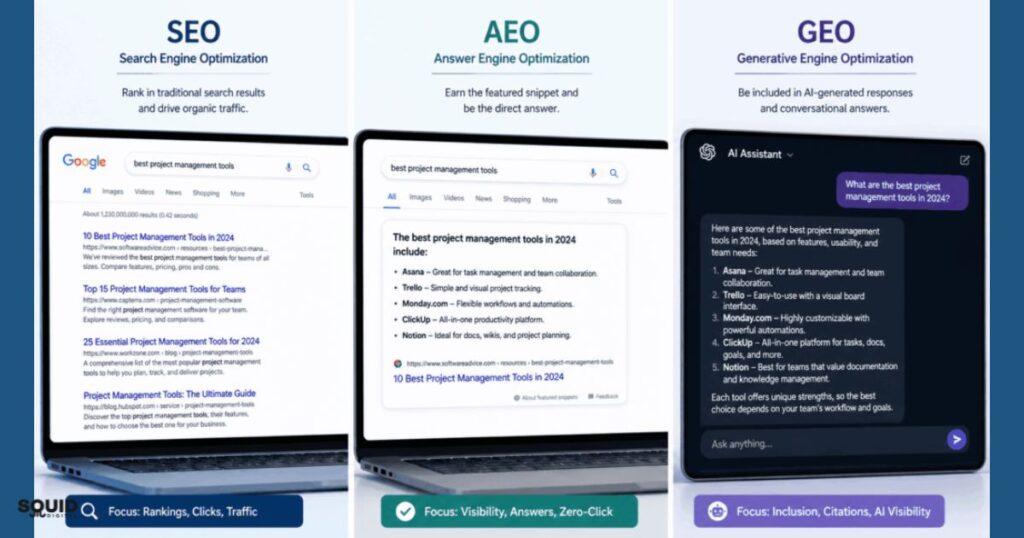
The difference between SEO, AEO, and GEO comes down to how content is delivered to the user.
Side-by-Side Comparison
| Element | SEO | AEO | GEO |
| Primary Goal | Rank on search engines | Provide direct answers | Be included in AI-generated responses |
| Content Style | Long-form, keyword-driven | Concise, question-based | Structured, contextual, layered |
| Optimisation Focus | Keywords, backlinks | Answer clarity, formatting | Context, entities, semantic depth |
| Platforms | Google, Bing | Featured snippets, voice search | AI tools, generative search |
| Success Metrics | Traffic, rankings | Snippet visibility | AI mentions, citations |
Where the Lines Blur
In practice, these approaches overlap more than they differ.
- Strong content benefits all three
- Clear structure improves both snippets and AI extraction
- Authority and trust signals remain critical
Key takeaway:
- SEO brings users in
- AEO captures attention
- GEO builds long-term visibility
Why This Shift Matters for Businesses in 2026
This shift isn’t theoretical—it’s already affecting how customers find and choose businesses.
The Rise of Zero-Click Search
More users now get answers without clicking.
That means:
- Less organic traffic
- More competition for visibility inside results
Changing Search Behaviour
Users are:
- Asking full questions instead of keywords
- Using voice and AI tools more frequently
- Expecting immediate clarity
This is a major behavioural shift—not just a technical one.
What This Means for Small Businesses
Smaller businesses actually have an advantage here.
You can:
- Compete without massive backlink profiles
- Win by being clearer and more helpful
- Leverage niche expertise
Risks of Ignoring AEO and GEO
If you stick to old SEO tactics:
- You may rank but not get clicks
- Competitors may appear in AI answers instead
- Your content may be overlooked entirely
Section recap:
- Visibility is shifting from links to answers
- Clarity beats complexity
- Adaptation is no longer optional
How SEO, AEO, and GEO Work Together (Not Against Each Other)
These are not competing strategies—they’re layers of the same system.
The Modern Content Ecosystem
Think of it this way:
- SEO = discoverability
- AEO = answer delivery
- GEO = AI amplification
Each plays a role in visibility.
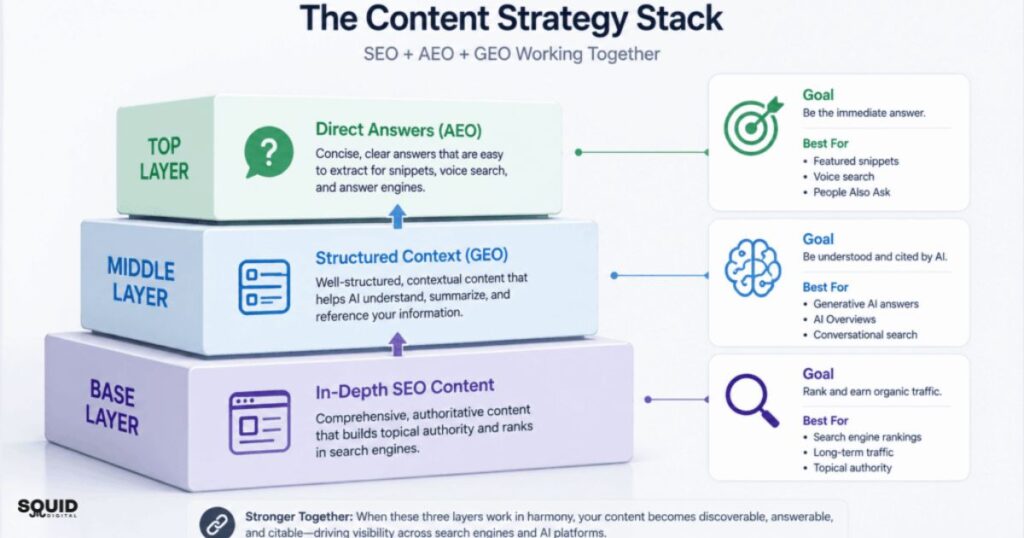
Layered Content Strategy
A well-optimised page includes:
- Top layer: Direct answers (AEO)
- Middle layer: Structured explanations (GEO)
- Base layer: In-depth authority (SEO)
This structure allows content to perform across multiple platforms.
What an Optimised Page Looks Like
Effective pages share common traits:
- Clear question-based headings
- Short, direct answers first
- Supporting explanations below
- Logical flow and formatting
This format helps both users and AI systems understand your content quickly.
A Practical Framework to Optimise for SEO, AEO and GEO
To succeed with SEO vs AEO vs GEO, you need a repeatable process—not guesswork.
Step-by-Step Process
- Identify real user questions
Focus on what people are actually asking, not just keywords. Use customer queries, FAQs, and search data. - Answer the question immediately
Provide a clear 40–60 word answer at the top of each section. This improves AEO performance. - Expand with structured depth
Add detailed explanations using headings, bullet points, and examples. - Incorporate semantic context
Include related terms and concepts to strengthen GEO signals and topical relevance. - Optimise formatting for extraction
Use:- Bullet points
- Tables
- Short paragraphs
- Demonstrate credibility
Add real insights, examples, or data. AI systems prioritise trustworthy content.
Quick Optimisation Checklist
- Does each section answer a clear question?
- Is the content easy to scan?
- Are key answers visible immediately?
- Is the structure logical and consistent?
- Would an AI tool easily extract this content?
Real-World Example: Applying This Strategy in a Small Business
Scenario: Local Accounting Firm in Australia
Situation:
A small accounting firm wants to rank for “small business tax advice Australia”.
Action:
They restructure their website content:
- Add clear questions like:
- “What tax deductions can small businesses claim?”
- “How much tax does a small business pay?”
- Provide direct answers first
- Use bullet points and website structured explanations
Outcome:
- Increased visibility in featured snippets
- Higher chance of being included in AI-generated summaries
- Improved engagement and enquiries
Why This Works
- The content matches real user questions
- It’s easy for both users and AI to understand
- It balances clarity with depth
Common Mistakes When Trying to Optimise for AEO and GEO
Treating It as “Just Another SEO Trend”
This leads to:
- Minimal changes in content structure
- Missed opportunities for visibility
Overloading Content with Keywords
Keyword stuffing:
- Reduces readability
- Confuses AI systems
Writing Without Clear Structure
Large text blocks:
- Are hard to scan
- Are difficult for AI to extract
Ignoring User Intent
Content that doesn’t answer real questions:
- Fails across SEO, AEO, and GEO
Lack of Depth or Context
Thin content:
- Won’t rank well
- Won’t be trusted by AI
Experience insight:
Many businesses update keywords but ignore structure. In practice, restructuring content often delivers faster results than rewriting it entirely.
Where to Focus Your Efforts Moving Forward
Prioritise Clarity and Simplicity
Clear, direct explanations outperform complex writing.
Build Topical Authority Over Time
- Create clusters of related content
- Cover topics in depth
Structure Content for Humans and Machines
Use:
- Headings
- Lists
- Logical flow
Measure What Actually Matters
Move beyond rankings:
- Featured snippet visibility
- Engagement
- AI-driven exposure
Industry trend:
AI-generated search results are expanding rapidly, meaning content visibility is increasingly tied to structure and clarity—not just backlinks.
Frequently Asked Questions About SEO vs AEO vs GEO
What is the difference between SEO, AEO, and GEO?
SEO focuses on rankings, AEO focuses on direct answers, and GEO focuses on appearing in AI-generated responses.
Each serves a different stage of visibility but works best together.
Is SEO still important in 2026?
Yes—SEO remains essential.
It provides the foundation for discoverability, even as AI layers change how results are displayed.
How do I optimise content for AI search engines?
Start with clear answers, structured formatting, and strong context.
AI systems prioritise content that is easy to interpret and trustworthy.
What is an example of AEO in action?
A featured snippet answering a question directly in search results.
This often appears above traditional listings.
Do small businesses need GEO strategies?
Yes—GEO offers a major opportunity.
Small businesses can compete by providing clear, expert-driven content.
Can one article target SEO, AEO, and GEO?
Absolutely.
With proper structure, a single page can rank, answer, and be cited by AI systems.
How long should answers be for AEO?
Typically 40–60 words.
This length is ideal for extraction in snippets and AI summaries.
What tools help with AEO and GEO optimisation?
Keyword tools, SERP analysis, and AI content tools can help identify opportunities and improve structure.
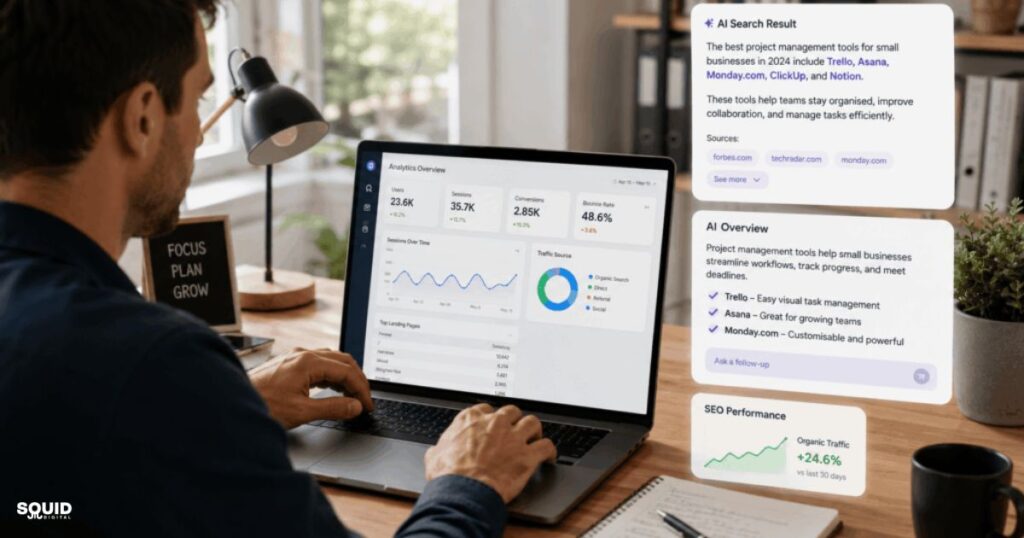
What Actually Matters Most in 2026
The real takeaway from SEO vs AEO vs GEO is this: visibility is no longer about ranking alone.
Success now depends on:
- Answering real questions clearly
- Structuring content for easy extraction
- Building authority over time
Businesses that combine:
- Depth (SEO)
- Clarity (AEO)
- Context (GEO)
…will be the ones that stay visible as search continues to evolve.
Putting This Into Practice
Start by reviewing one key page on your website—rewrite it to answer questions clearly, structure it properly, and make it easy to extract. Small changes in clarity and format can make a significant difference.
Want to improve your visibility across search engines and AI platforms? Contact us now to discuss a practical SEO, AEO, and GEO strategy tailored to your business.
Subscribe to our LinkedIn newsletter for practical insights, AI search trends, and actionable content strategies to stay ahead in 2026.