
AI Visibility: What Makes a Business Visible in ChatGPT and AI Search
Introduction
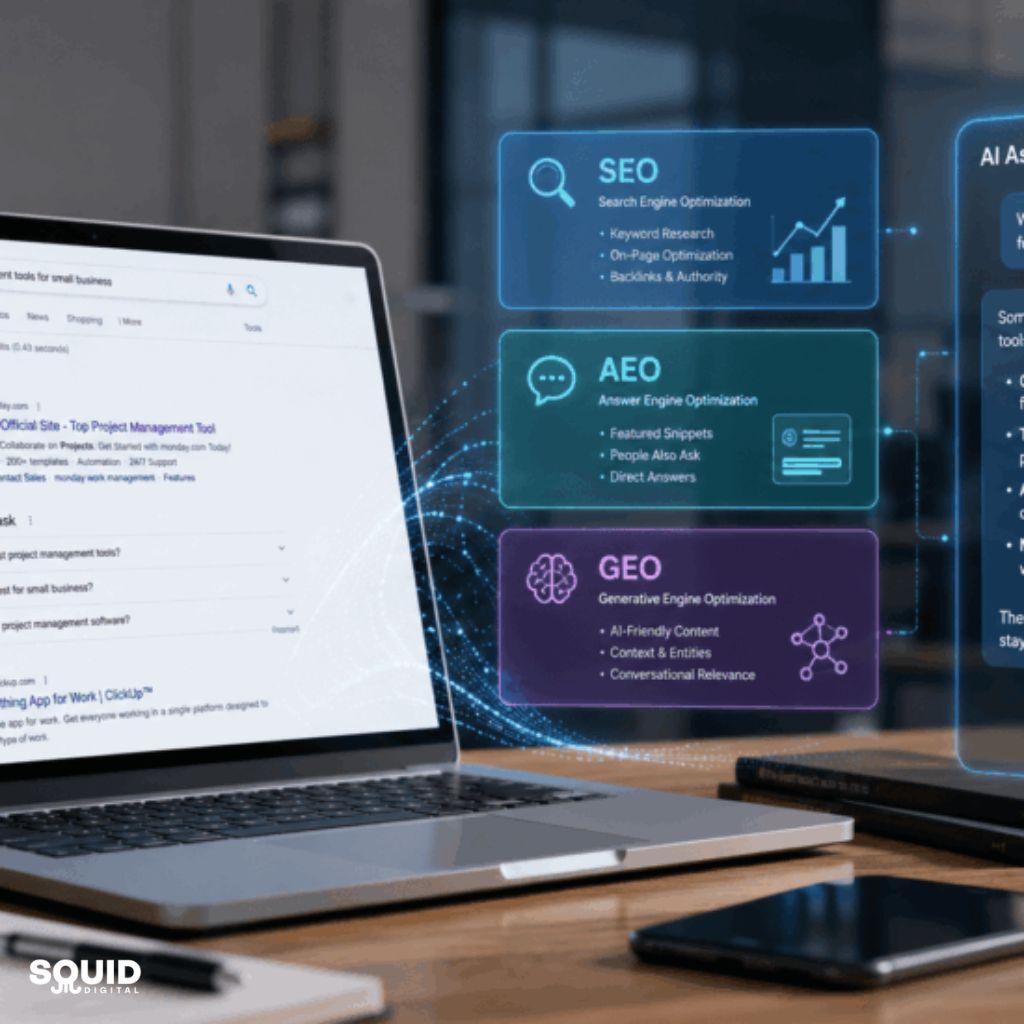
AI Visibility is quickly becoming the new battleground for online discovery. More people are now asking tools like ChatGPT instead of scrolling through Google results — and that shift is changing which businesses get seen, trusted, and chosen.
The problem? Many businesses that rank well on Google are completely invisible in AI-generated answers.
That’s because AI search doesn’t work the same way. It doesn’t just list websites — it selects, summarises, and recommends. If your business isn’t structured in a way AI understands and trusts, you simply won’t show up.
This article breaks down exactly what makes a business visible in ChatGPT and AI search. You’ll learn how AI decides who to recommend, why some businesses are consistently included, and what practical steps you can take to improve your visibility — especially if you’re a small or growing business.
How AI Visibility is determined by search engines and ChatGPT
The shift from ranking pages to selecting answers
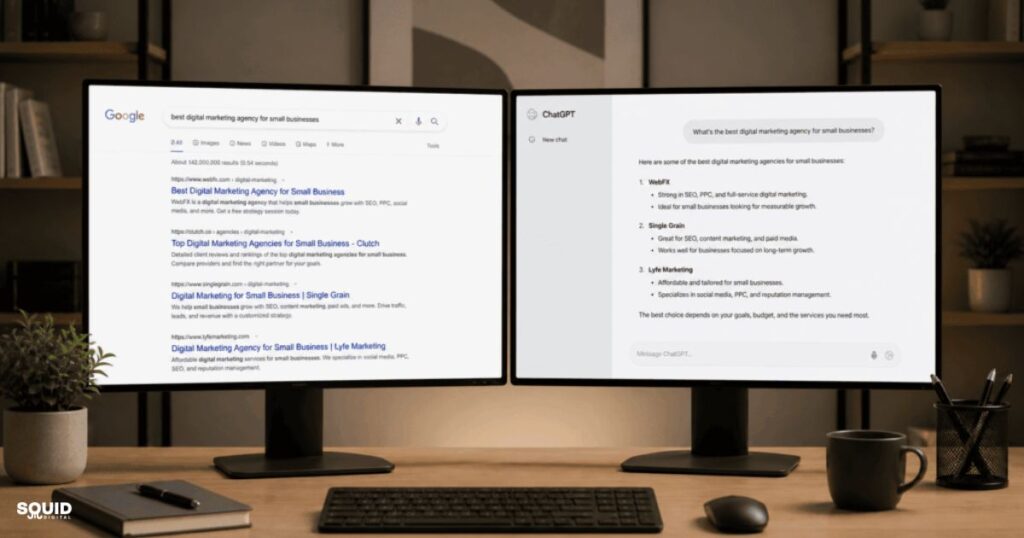
Traditional search engines rank pages. AI search engines generate answers.
This is a major shift. Instead of presenting ten blue links, AI tools combine information from multiple sources into one response. Your business isn’t competing for a position — it’s competing to be included.
That means:
- Relevance matters more than exact keyword matching
- Clarity matters more than clever optimisation
- Authority matters more than sheer volume of content
If your content doesn’t clearly answer a question, it’s unlikely to be used.
Key signals AI systems prioritise
AI systems rely on a combination of signals to decide what to include in their answers. These go beyond traditional SEO metrics.
Key factors include:
- Topical authority: How well you cover a subject overall
- Entity recognition: Whether your business is clearly defined and understood
- Consistency: Matching information across platforms
- Credibility: External validation like reviews and mentions
AI isn’t just looking for content — it’s looking for reliable sources.
What “entity recognition” means in practice
Entity recognition is about your business being seen as a clearly defined “thing” online.
In practical terms:
- Your business name is consistent everywhere
- Your services are clearly described
- Your website, listings, and profiles align
For example, if your website says “digital marketing agency” but your listings say “web design studio”, AI may struggle to confidently categorise you.
Clarity builds trust — and trust drives visibility.
Why some businesses appear in ChatGPT while others don’t
The visibility gap most businesses don’t realise
Many business owners assume that having a website is enough. It’s not.
AI tools favour businesses that:
- Provide clear, structured information
- Are referenced across multiple sources
- Demonstrate expertise in a specific area
If your content is vague or generic, AI has little reason to include it.
Common reasons businesses get ignored
There are a few recurring issues that limit AI visibility:
- Thin content that doesn’t fully answer questions
- Overly broad or unclear service descriptions
- Inconsistent branding across platforms
- No external mentions or authority signals
Even a well-designed website can be invisible if it lacks depth and clarity.
Signals that increase AI inclusion
To improve your chances of appearing in AI-generated answers, focus on signals that indicate trust and relevance.
These include:
- Being mentioned on other websites (blogs, directories, media)
- Clear, direct explanations of your services
- Content that answers real customer questions
- Strong reviews and testimonials
AI systems are essentially asking: “Is this a reliable source worth referencing?”
The core building blocks of AI visibility for modern businesses
Content that answers real questions
The most effective content mirrors how people actually search.
Focus on questions like:
- How does this service work?
- What does it cost?
- Is it worth it?
- What are the best options?
Content that directly answers these questions is far more likely to be used by AI.
Authority through depth, not volume
Publishing more content doesn’t automatically improve visibility.
Instead:
- Create fewer, higher-quality pages
- Cover topics in depth
- Provide clear, practical explanations
A detailed guide on one topic is often more valuable than dozens of shallow posts.
Consistency across the web
Consistency helps AI confidently identify and trust your business.
Make sure your:
- Business name
- Services
- Location (if relevant)
…are consistent across:
- Your website
- Google Business Profile
- Industry directories
Even small inconsistencies can weaken your visibility.
Trust signals AI can detect
AI systems look for indicators that your business is credible.
Important signals include:
- Customer reviews
- Backlinks from reputable websites
- Mentions in articles or listings
These signals reinforce that your business is legitimate and trusted.
SEO vs AI visibility: what’s changing and what still matters
Where traditional SEO still plays a role
SEO is still important — it just isn’t the full picture anymore.
Key elements that still matter:
- Site speed and technical performance
- Keyword relevance
- Backlinks
These factors help your content get discovered in the first place.
Where AI search changes the game
AI search shifts the focus towards understanding and trust.
Key differences:
- Less emphasis on ranking position
- More emphasis on clarity and usefulness
- Greater importance of context and authority
You’re no longer optimising just for search engines — you’re optimising for understanding.
Side-by-side comparison
| Factor | Traditional SEO | AI Visibility (ChatGPT & AI Search) |
| Goal | Rank on search results pages | Be selected as part of an answer |
| Focus | Keywords and links | Meaning, context, and trust |
| Content style | Optimised for search engines | Optimised for understanding |
| Success metric | Page position | Inclusion in AI responses |
| Strategy | Ranking higher than competitors | Becoming the most credible source |
Practical ways to improve your AI visibility in AI-generated answers
Structure your content for AI extraction
AI prefers content that is easy to scan and interpret.
Use:
- Clear headings (H2, H3)
- Short paragraphs
- Bullet points for key ideas
This makes it easier for AI to extract and reuse your content.
Create “answer-first” content blocks
Each section of your content should answer a specific question immediately.
For example:
- Start with a direct answer
- Follow with supporting detail
This structure aligns perfectly with how AI generates responses.
Build topical authority in your niche
Instead of covering everything, focus on one area.
For example:
- A plumber focuses on drainage and emergency repairs
- A marketing agency focuses on SEO or AI visibility
Then build content around:
- Services
- Common problems
- Solutions
This signals expertise.
Quick wins businesses can implement today
If you want immediate improvements, start here:
- Add FAQ sections to key pages
- Improve clarity on service pages
- Ensure consistent business details across platforms
- Publish one in-depth guide on your core service
Small changes can have a big impact over time.
Real-world scenarios: how different businesses gain AI visibility
Local service business (e.g. plumber or electrician)
A local plumber creates pages like:
- “How to fix a blocked drain”
- “Emergency plumbing costs in your area”
They also:
- Build strong reviews
- List their business in directories
Result: AI tools are more likely to reference them for local queries.
eCommerce brand
An online store improves visibility by:
- Creating buying guides
- Writing product comparisons
- Optimising product descriptions
They also gain mentions from review sites.
This builds authority and increases inclusion in AI-generated recommendations.
Professional service (consultant, agency)
A consultant or agency publishes:
- Thought leadership content
- Detailed guides
- Industry insights
They answer niche-specific questions clearly and consistently.
Over time, this positions them as a trusted source.
Mistakes that reduce your chances of being recommended by AI
Writing for algorithms instead of humans
Over-optimised content often feels unnatural.
Examples include:
- Keyword stuffing
- Forced phrasing
AI systems prioritise clarity and usefulness, not manipulation.
Lack of clarity about what you actually do
If your messaging is vague, AI won’t understand your business.
Avoid:
- Generic descriptions
- Buzzwords without explanation
Be specific about your services and expertise.
Ignoring external signals
If your business only exists on your website, it lacks credibility.
Build:
- Backlinks
- Mentions
- Reviews
These signals reinforce trust.
Treating AI visibility as a “quick fix”
AI visibility is not a one-time task.
It requires:
- Consistent content
- Ongoing optimisation
- Long-term authority building
Businesses that commit early gain the biggest advantage.
Why AI visibility matters more for small businesses than ever
Reduced reliance on traditional rankings
Small businesses no longer need to outrank large competitors to be seen.
AI tools can surface:
- Niche experts
- Highly relevant businesses
This levels the playing field.
Opportunity to become a trusted source
If your content is clear and helpful, you can outperform bigger brands.
Authority is now based on:
- Usefulness
- Clarity
- Relevance
Not just brand size.

Long-term advantage for early adopters
Businesses that invest in AI visibility now can:
- Build stronger digital authority
- Become go-to references in their niche
This creates a lasting competitive edge.
Frequently Asked Questions
Can my business appear in ChatGPT results?
Yes — if your content is clear, trusted, and widely referenced. AI tools pull from multiple sources, so your overall digital presence matters.
Is SEO still important for AI search?
Yes, but it’s evolving. SEO provides the foundation, while AI visibility builds on clarity, structure, and authority.
How long does it take to become visible in AI search?
It can take weeks to months. Consistency in content, mentions, and authority signals plays a major role.
Do I need to create different content for AI tools?
Not entirely. You need to structure your content better so it’s easier for AI to understand and extract.
What type of content performs best in AI answers?
Direct answers, guides, FAQs, and comparison content perform best because they clearly solve user problems.
Do reviews and backlinks affect AI visibility?
Yes — they act as trust signals. AI systems favour businesses that show credibility across multiple sources.
Can small businesses compete with large brands in AI search?
Absolutely. Niche expertise and clear, helpful content can outperform larger but more generic competitors.
Key takeaways for improving your AI visibility
AI visibility is less about gaming algorithms and more about being genuinely useful and trustworthy.
Key points to remember:
- AI prioritises clarity, authority, and trust
- Being understood matters more than simply ranking
- Strong content and consistent presence drive visibility
- Small businesses have a real opportunity to compete
- Long-term effort delivers the best results
Where to start with AI visibility
If you want to improve your AI visibility, start simple.
Review your website and ask:
- Does it clearly explain what you do?
- Does it answer real customer questions?
Then take action:
- Improve one key service page
- Add a helpful FAQ section
- Publish one in-depth guide
Focus on clarity, consistency, and usefulness — and over time, your business becomes far more likely to be recommended by AI.
Want to improve your AI visibility strategy? Contact us now.
Subscribe to our LinkedIn newsletter for more insights on SEO, AEO, and GEO.