

Simple Yet Powerful Tips to Help AI Understand Your Website

Learning how to help AI understand your website is becoming increasingly important for businesses that rely on online visibility. Search engines are evolving beyond traditional keyword matching, and AI systems now analyse context, structure, relationships, and meaning when interpreting web pages.
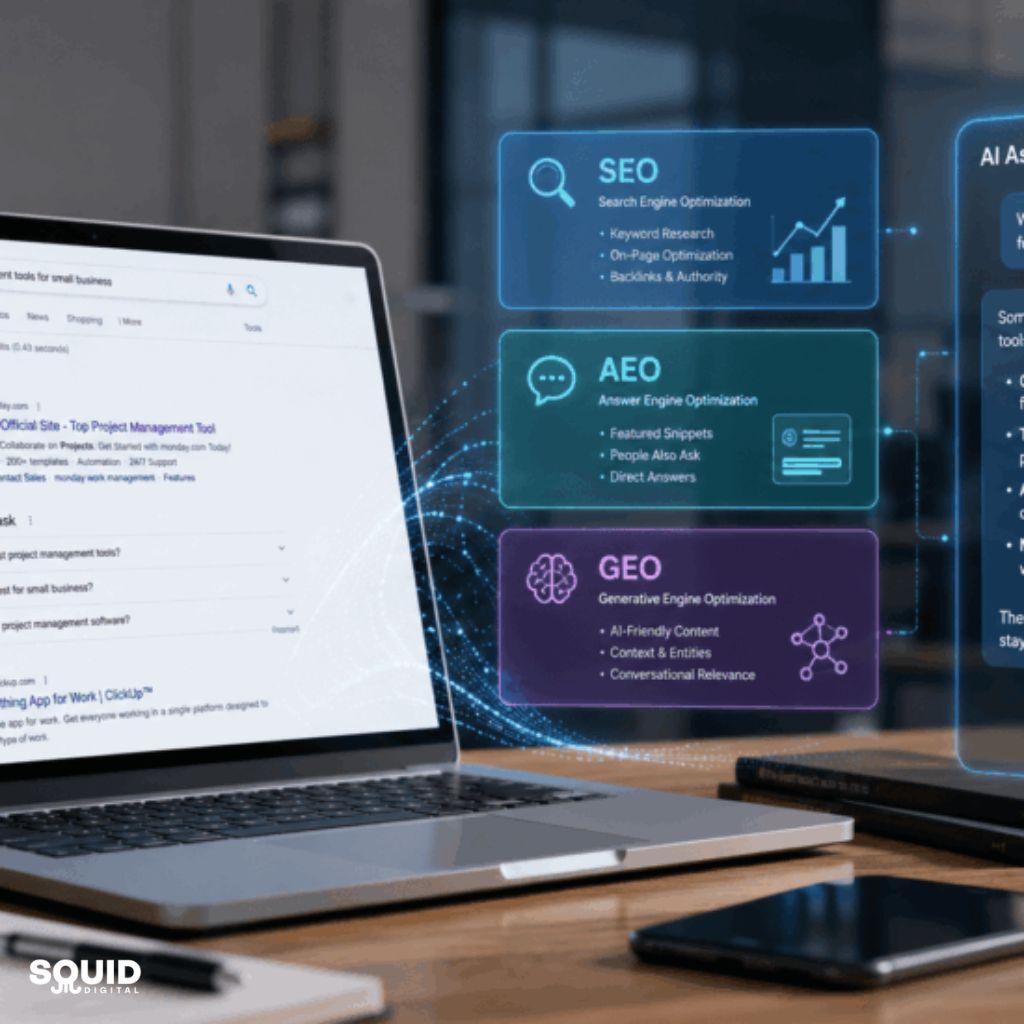
Today, platforms like Google AI Overviews, ChatGPT, Perplexity, and other answer engines are changing how users discover information online. Instead of simply showing a list of websites, AI tools often summarise answers directly from multiple sources. If your website content is unclear, poorly structured, or difficult to interpret, your business may struggle to appear in these AI-generated responses.
The good news is that making a website AI-friendly does not require complex technical knowledge. In many cases, improving clarity, structure, and usability can significantly help both search engines and AI systems understand your content better.
This guide explores practical strategies to improve website clarity, strengthen SEO and GEO performance, and help your business stay visible as AI-driven search continues to grow.
Why AI Understanding Matters for Modern Websites
AI-driven search systems are designed to interpret meaning, intent, and relationships between topics. This means websites must communicate information clearly rather than relying solely on keywords.
The Shift From Traditional Search to AI-Driven Discovery
Traditional SEO focused heavily on rankings and keyword optimisation. While keywords still matter, AI systems now evaluate:
- Content structure
- Topic relevance
- Semantic relationships
- Contextual meaning
- User-focused answers
AI-powered tools are increasingly generating direct answers instead of sending users through multiple search results. Businesses that provide structured and easy-to-understand content are more likely to be included in those answers.
What Happens When AI Cannot Understand Your Website
When website content lacks clarity, AI systems may struggle to interpret what the page is actually about. This can lead to:
- Reduced visibility in AI search results
- Lower topical authority
- Poor indexing accuracy
- Weak relevance signals
- Missed organic traffic opportunities
Even useful content can underperform if it is poorly organised.
Why Small Businesses Should Care
Small businesses often compete against larger brands with bigger marketing budgets. AI-friendly content helps level the playing field by rewarding clarity and usefulness.
A well-structured local service page or informative blog article may perform better than a large but confusing website. This is especially important for niche businesses and local service providers.
How AI Systems Read and Interpret Website Content
AI systems analyse both visible content and structural signals to understand webpages. They look for patterns that help determine meaning, relevance, and trustworthiness.
The Key Signals AI Uses to Understand Pages
Some of the most important signals include:
- Heading hierarchy
- Internal linking
- Structured data
- Page organisation
- Topical consistency
- Descriptive anchor text
- Contextual relationships
AI systems use these signals to connect ideas and understand how information fits together.
Human-Friendly vs AI-Friendly Content
Well-optimised websites typically perform well for both users and AI systems.
| Website Element | Human Benefit | AI Benefit |
|---|---|---|
| Clear headings | Easier reading | Better topic recognition |
| Structured content | Faster navigation | Improved context understanding |
| Internal linking | Better UX | Stronger topical relationships |
| Schema markup | Rich search results | Clear entity identification |
| FAQ sections | Quick answers | Easier AI extraction |
The Role of Context and Entity Recognition
AI tools rely heavily on entities and contextual relevance. An entity may include:
- Business names
- Locations
- Services
- Products
- Industries
- People
For example, if a plumbing company consistently references emergency plumbing, blocked drains, hot water repairs, and its service area, AI systems can better understand its expertise.
Using consistent terminology across pages strengthens those signals.
Simple Website Improvements That Help AI Understand Content Better

Making your website easier for AI to understand often starts with improving basic structure and clarity.
Write Clear and Descriptive Headings
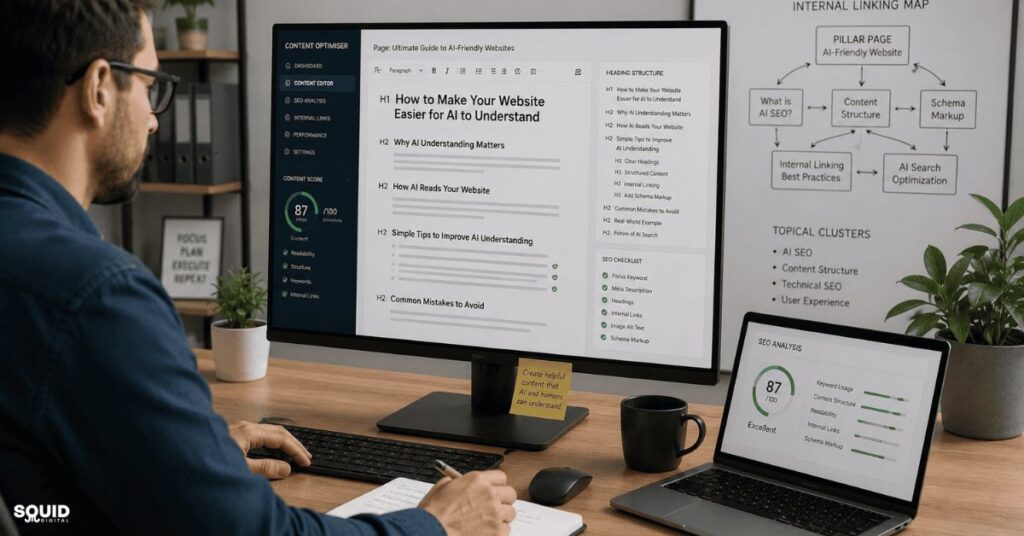
Headings help AI systems interpret page hierarchy and content relationships.
Instead of vague headings like:
- “Our Services”
- “What We Do”
- “Learn More”
Use clearer alternatives such as:
- “Emergency Plumbing Services in Sydney”
- “How Our SEO Strategy Works”
- “Website Design for Local Businesses”
Descriptive headings provide stronger contextual signals.
Organise Pages With Logical Content Structure
A well-organised page improves readability and interpretation.
Use:
- One clear H1 heading
- Logical H2 and H3 sections
- Short paragraphs
- Consistent formatting
Avoid mixing unrelated topics on the same page.
Improve Internal Linking
Internal links help AI systems understand relationships between pages.
For example:
- A service page can link to relevant blog articles
- Blog articles can connect to FAQs
- Related services can support each other
Descriptive anchor text is especially important.
Instead of:
- “Click here”
Use:
- “Learn more about local SEO services”
Use Consistent Language Across the Website
Changing terminology too often can confuse AI systems.
For example, avoid alternating between:
- “Digital marketing”
- “Online promotion”
- “Internet advertising”
- “Web visibility solutions”
Consistency strengthens topical clarity.
Make Key Information Easy to Find
AI systems prioritise websites that clearly present important information.
Key details should be visible and accessible:
- Contact information
- Business services
- Service areas
- Pricing information
- FAQs
- About page
Quick Recap
- Use descriptive headings
- Structure pages logically
- Improve internal links
- Keep terminology consistent
- Surface important business information clearly
A Practical Framework for Creating AI-Friendly Website Content

Businesses can simplify content optimisation by following a repeatable framework.
The C.L.E.A.R Framework
C — Clear Structure
Use logical headings, short paragraphs, and organised layouts.
AI systems process structured information more effectively than cluttered or disorganised pages.
L — Logical Navigation
Menus and page hierarchy should feel intuitive.
Users and AI systems should easily understand:
- What the business offers
- Where important information lives
- How topics connect
E — Entity-Based Content
Clearly mention:
- Services
- Locations
- Industries
- Expertise
- Product categories
This helps AI identify your website’s core relevance.
A — Answer-Focused Writing
AI search increasingly rewards direct answers.
Start sections with concise explanations before expanding into detail.
R — Relevant Internal Relationships
Connect related content strategically.
For example:
- SEO services → SEO audit blog
- Web design → UX optimisation guide
- Local SEO → Google Business Profile article
Quick Wins Checklist for Small Businesses
- Add FAQ sections to important pages
- Improve title tags and meta descriptions
- Update outdated blog content
- Create dedicated service pages
- Improve page loading speed
- Add schema markup where possible
Step-by-Step Process to Make Your Website Easier for AI to Understand
- Audit your website structure
Review headings, navigation, and content organisation to identify confusing sections. - Improve page clarity
Rewrite vague headings and simplify content where needed. - Strengthen internal linking
Connect related pages using descriptive anchor text. - Create answer-focused content
Add FAQs and concise explanations that directly answer common questions. - Optimise for consistency
Use consistent terminology across all pages and blog posts. - Refresh outdated content regularly
AI systems favour accurate and relevant information.
Common Website Mistakes That Confuse AI Systems
Some common SEO habits can actually weaken AI understanding.
Overusing Keywords Unnaturally
Keyword stuffing creates awkward and unnatural content.
Modern AI systems prioritise:
- Meaning
- Context
- Relevance
- Readability
Natural language performs better than repetitive optimisation.
Poor Website Structure
AI systems struggle with:
- Missing headings
- Thin pages
- Duplicate content
- Orphan pages
- Disorganised navigation
A poor structure weakens topical clarity.
Relying Too Heavily on Images Without Context
Images alone rarely provide enough information.
Important content should not exist only inside graphics or banners. Supporting text, captions, and alt text help AI systems interpret visuals properly.
Publishing Generic Content With No Real Expertise
Generic content often lacks originality and practical value.
Websites that demonstrate experience, expertise, authority, and trustworthiness tend to perform better in both SEO and AI-generated search experiences.
Common Mistakes Summary
- Keyword stuffing
- Weak page structure
- Poor internal linking
- Generic content
- Missing context around visuals
Real-World Example of an AI-Friendly Website Improvement
A small local accounting business struggled to attract organic traffic despite offering quality services.
Before Optimisation
The website had:
- Generic service pages
- Weak heading structure
- Minimal internal linking
- No FAQs
- Confusing navigation
AI systems likely struggled to identify the business’s areas of expertise.
Changes Implemented
The business made several improvements:
- Rewrote headings with clear service intent
- Added location-specific service pages
- Created FAQ sections for each service
- Improved internal linking between pages
- Added schema markup and clearer metadata
The Outcome
Within several months, the website experienced:
- Better search visibility
- Increased user engagement
- Higher-quality enquiries
- Improved indexing consistency
The content became easier for both users and AI systems to interpret.
What Small Businesses Can Learn From This
Small structural improvements can create meaningful results over time.
In many cases, businesses do not need hundreds of new pages. They simply need clearer organisation and more helpful content.
Preparing Your Website for the Future of AI Search

AI-driven search will continue evolving rapidly over the coming years.
Why AI Search Will Continue to Evolve
Search behaviour is becoming more conversational.
Users increasingly ask:
- Longer questions
- Problem-solving queries
- Context-rich searches
AI systems are adapting by generating summarised answers rather than simple lists of links.
Future-Proof Strategies That Still Matter
Despite technological changes, several core principles remain important:
- Helpful content
- Clear website structure
- Strong topical authority
- Fast user experience
- Content freshness
These foundations support both SEO and GEO performance.
Areas Worth Prioritising Over the Next 12 Months
Businesses should focus on:
- Updating outdated content
- Expanding topical depth
- Improving structured data
- Creating answer-focused pages
- Strengthening internal linking
An important industry trend is the growing emphasis on entity-based SEO. AI systems increasingly evaluate how clearly businesses define their expertise, services, and relationships between topics.
Building a Website That Both People and AI Can Understand
Creating an AI-friendly website is ultimately about clarity.
When your website is easy for people to navigate and understand, it also becomes easier for AI systems to interpret. Strong headings, organised content, internal linking, and answer-focused writing all contribute to better visibility.
Businesses that adapt early to AI-driven search trends may gain a long-term advantage as answer engines become more influential.
The most effective strategy is not chasing algorithms. It is creating genuinely useful, structured, and trustworthy content that clearly communicates value.
Take the Next Step Towards an AI-Ready Website

Improving website clarity does not require a complete redesign. Small adjustments to structure, content, and organisation can significantly improve how AI systems interpret your website.
Start by reviewing your most important pages, simplifying headings, improving internal links, and answering common customer questions more directly. Consistent improvements over time often deliver the strongest long-term results.